Body before chat
An agent gets a sprite, a seat, and a walk path before it gets a prompt box.
UX case study · 2026 · Solo build
I didn’t start from “make a prettier homepage.” I started from a simpler itch: if I already have agents doing work, why can’t I see them working? A log is proof. A room is company. I wanted the workstation to be more interesting than a status list.
01
Most “agent” UIs are a chat thread plus a spinner. That’s honest, and also dead. You ask, you wait, a paragraph comes back. Nothing in the interface has a body, a job, or a place to stand. I was already wiring real work — Etsy, a trade desk, Gmail, site visits — into one local homepage. The agents were doing things. I just couldn’t watch them.
So the brief I wrote for myself was not “add AI.” It was: visualize the agents so the workstation feels staffed. If Pip published five listings, I want to see her at a desk, not a green badge on a card. If Rex armed the tape, I want him to say it. Fun was the requirement, not the decoration.
If an agent only exists as text, I treat it like a tool. If it walks across a room, I treat it like a coworker — and I actually look up.
An agent gets a sprite, a seat, and a walk path before it gets a prompt box.
Rex is tape. Pip is shop. Nox is mail and the door. No omni-bot.
They idle, sit, and speak when work finishes. They don’t dance for attention.
02
Before desks, before chairs, before anyone sat down, I had a room. Colored rugs on the wood. A window. Space. That picture was the first wireframe: not boxes on a page, but slots an agent could occupy.
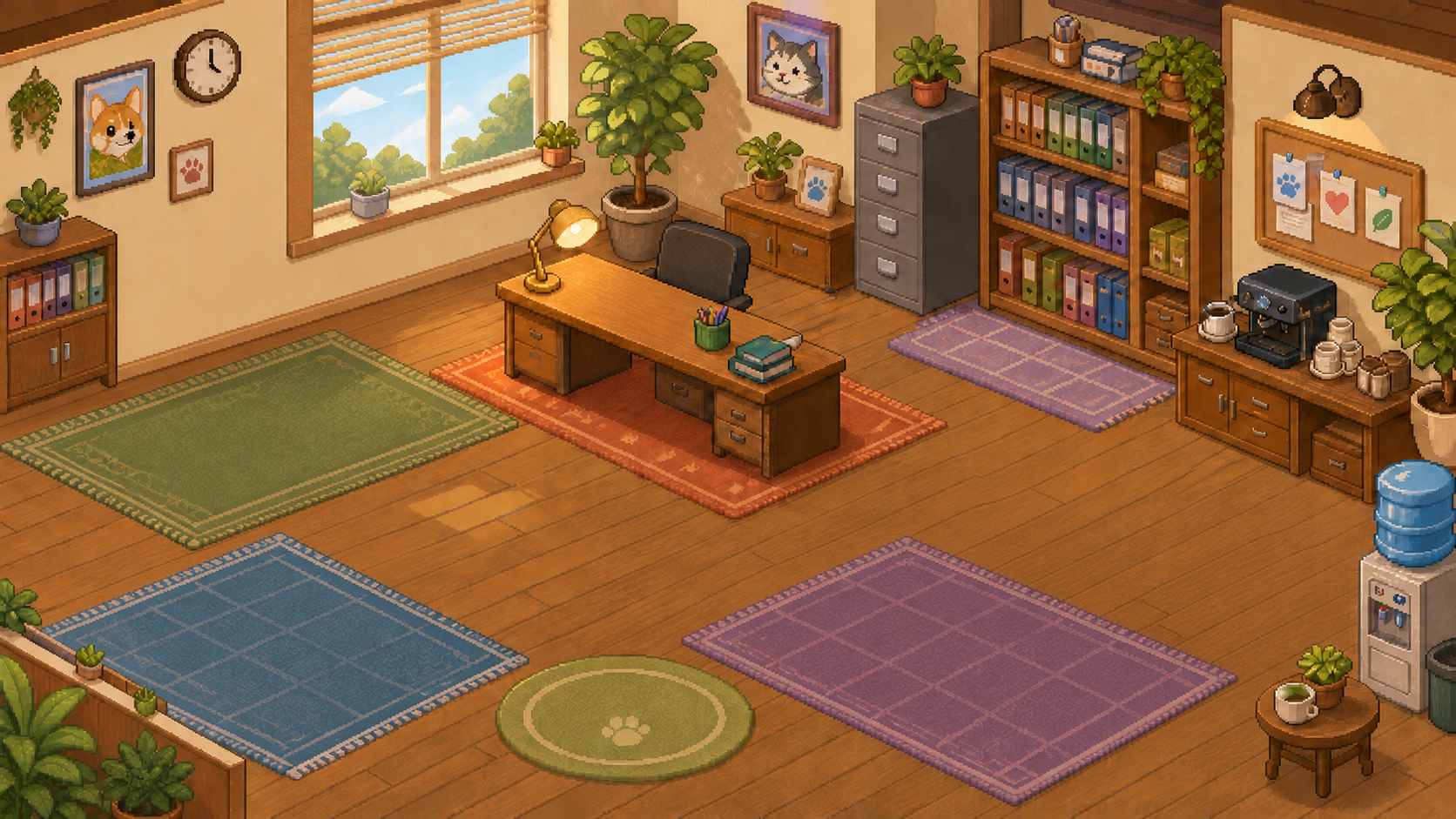
A dashboard has no empty state that feels like morning. A room does. Looking at this, I could decide: Pip lives on the back left rug, Rex closer to the front, Nox by the window wall. The layout is a team map. I placed furniture later, as stickers, because the agents needed tables to stand behind — not because I wanted more pixels.
That order mattered. If I had drawn three perfect desks first, I would have designed a diorama. Starting empty forced the real question: where does an agent go when it has news? Walk, sit, face me, speak. The furniture is there to make that readable.
A place with light and floor zones. No jobs yet. You can feel the scale.
Three pets drop onto the rugs. They wander. The room is suddenly occupied.
Each job gets a table and a chair. Sitting becomes a status: “this lane is working.”
Bubbles, jump links, a meeting bar. The agents can report and take a task.
03
I could have shown agents as nodes, timelines, or token meters. That’s visualization too — and it still looks like software. I wanted visualization that a tired person understands in one glance: who is here, what they own, did they finish.

Trader
Lives at the front-left desk. Reads QQQ, flags account risk, says when the tape is armed. His bubble is the color of the trade ticket.

Shop
Back-left ecommerce desk. Walks a short path to her chair, sits, and tells me how many listings went live. The shop lane has a body now.

Intel
Window-side intel desk. Gmail and site visits. If a friend in San Francisco opened the site, he says it out loud instead of hiding it in analytics.
Before
A card says “5 listings.” A toast says “new mail.” I nod and forget. Nothing has weight. The workstation is a switchboard.
After
Pip sits down and speaks. I can click through to Etsy from her sentence. The same fact, but I remember it because someone said it from a desk.
04
Visualization only works if I can build the stage. The right panel is not a settings dump — it is how an agent gets a floor, a desk, and a path. I kept it next to the canvas so I never leave the room to change the room.
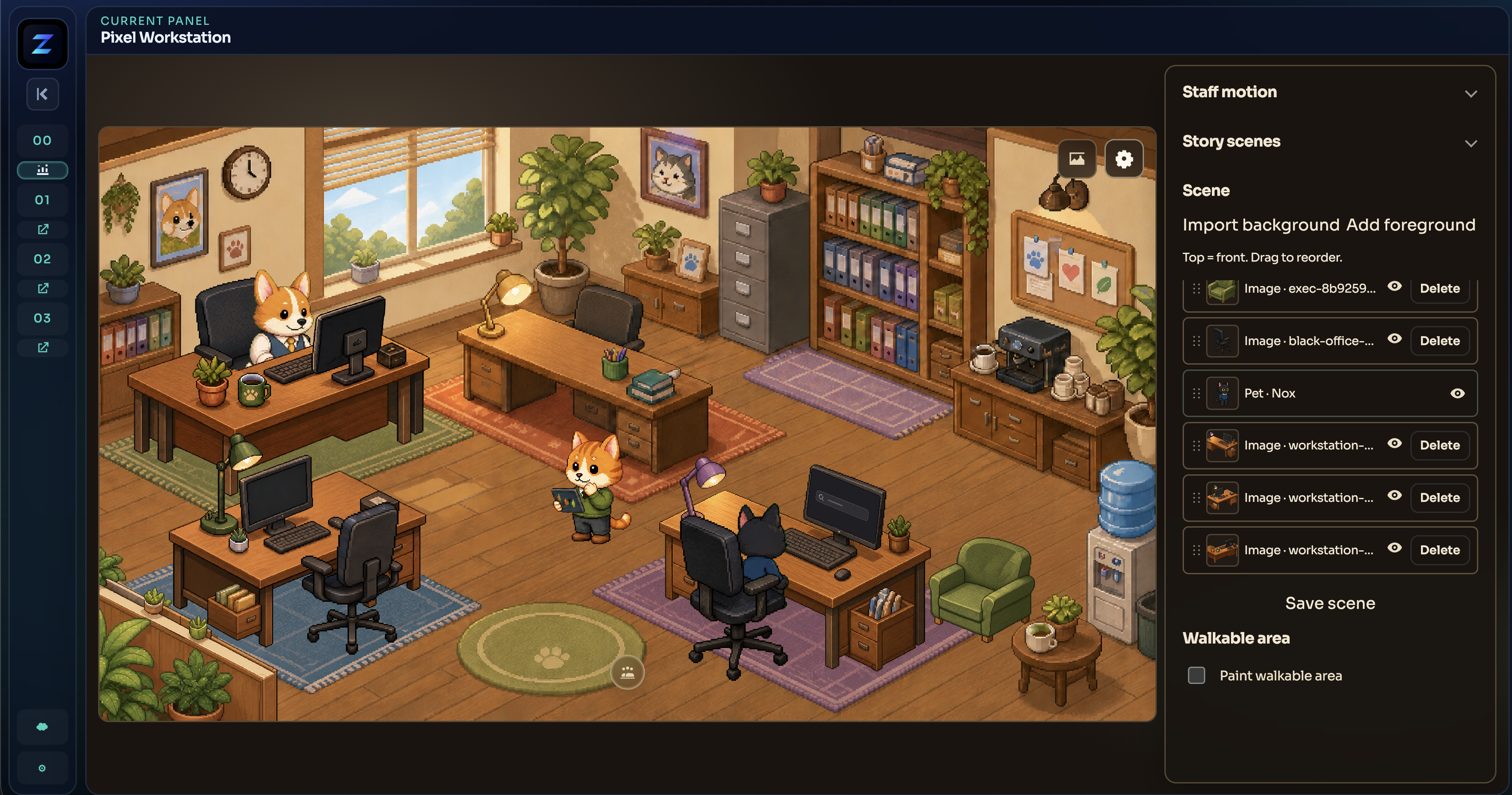
Animation speed and how often they sit down to work. A visit bubble can meow — quiet enough that it is a glance, not an alarm.
Scene 1 plays on this floor. The story is a button in the same panel, not a separate movie.
Import a background, drop furniture as foreground. Top is front. Drag to reorder, hide, or delete. Pets are layers too — I can put Rex in front of a desk or behind it.
I @ someone in the bar, they turn to the circle, and the log stays on the floor. Rex, Pip, and Nox sit in the same meeting — trader, shop, intel.
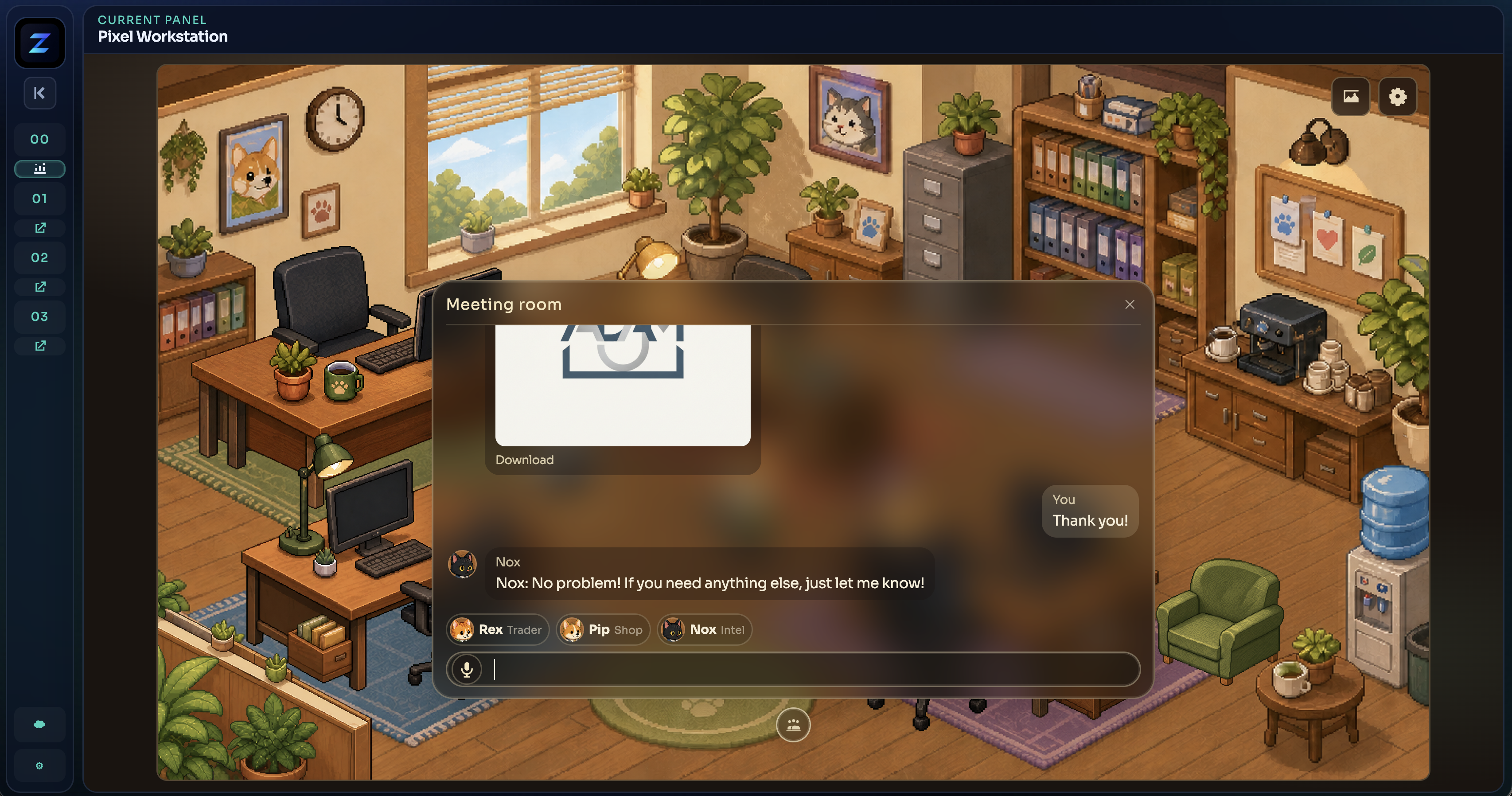
Live work still comes through the same bodies: Etsy counts, trade alerts, Gmail, site visits. The editor decides where those bodies are allowed to stand when they have something to say.
05
Once the room could hold agents, I needed a scene that used them — not a feature tour. Scene 1 is a morning brief I can play. It is also the thesis: if the agents are visible, the day can start as a conversation.
I just woke up.
Five products are already live on Etsy.
Shop’s steadier than the tape. Then he reads Aug 14 QQQ premarket and says automated trading is ready. Armed.
Mail is sorted. Latest is Adam — 11am meeting. Also, a friend in San Francisco visited the site today.
That buyer from yesterday?
@Nox, make a logo from the name Adam. Keep it simple and elegant.
Done — take a look.
Scene 1 is staged so I can show the idea in two minutes. The live office uses the same bodies: real Etsy counts, real trade alerts, real mail and visits. Visualization first, then the pipes.
06
A visualized agent fails the moment the picture lies. If Pip speaks from behind a desk that paints over Rex, or a chair floats on a tabletop, the spell drops. The craft work was mostly about keeping the lie small.
After a finished task, a jump icon sits in the bubble. Etsy, Yahoo QQQ, the trade board, Gmail, site admin. The agent points at the real system. Visualization is not a dead end.
I type @Nox in the meeting bar. They face the
circle. Asking an agent to work should feel like turning
to a desk, not opening a modal.
Isometric rooms cheat. I locked Rex’s desk over Pip’s, kept chairs behind their own tables when empty, and lift a walking pet when their feet are closer to the camera. Charm dies if the layers are wrong.
Scene 1 plays on the same stage. When it ends, they wander again. I didn’t want a cutscene that leaves the product — that would make the agents fictional.
07
Pixel Workstation is an experiment in agent visualization. The bet is simple: if the work already happens, show it as people in a room, and the workstation gets more interesting — not because it is gamified, but because it finally has someone home. I still open the real tools. I just don’t start the day staring at them.